












You lead an architectural department in Ekaterinburg designing residential complexes. You've developed sophisticated expertise over years: understanding how to orchestrate team workflows, navigate local building codes, optimize layouts for residential markets, manage complex client relationships, and deliver projects successfully. Yet despite this deep knowledge, your compensation remains largely confined to your department salary and standard project fees.
This is the hidden tragedy of technical expertise: those who know the most often earn the least relative to their potential.
If you're a residential architecture leader anywhere—whether in Ekaterinburg or globally connecting to markets like Myanmar and Yangon—you have a critical asset sitting untapped: your accumulated knowledge. The systems you've built, the problems you've solved, the patterns you've discovered—these are precisely what emerging architects, smaller firms, and real estate developers are desperate to learn.
The question is not whether your knowledge has value. It clearly does. The question is: how do you package and monetize it effectively?
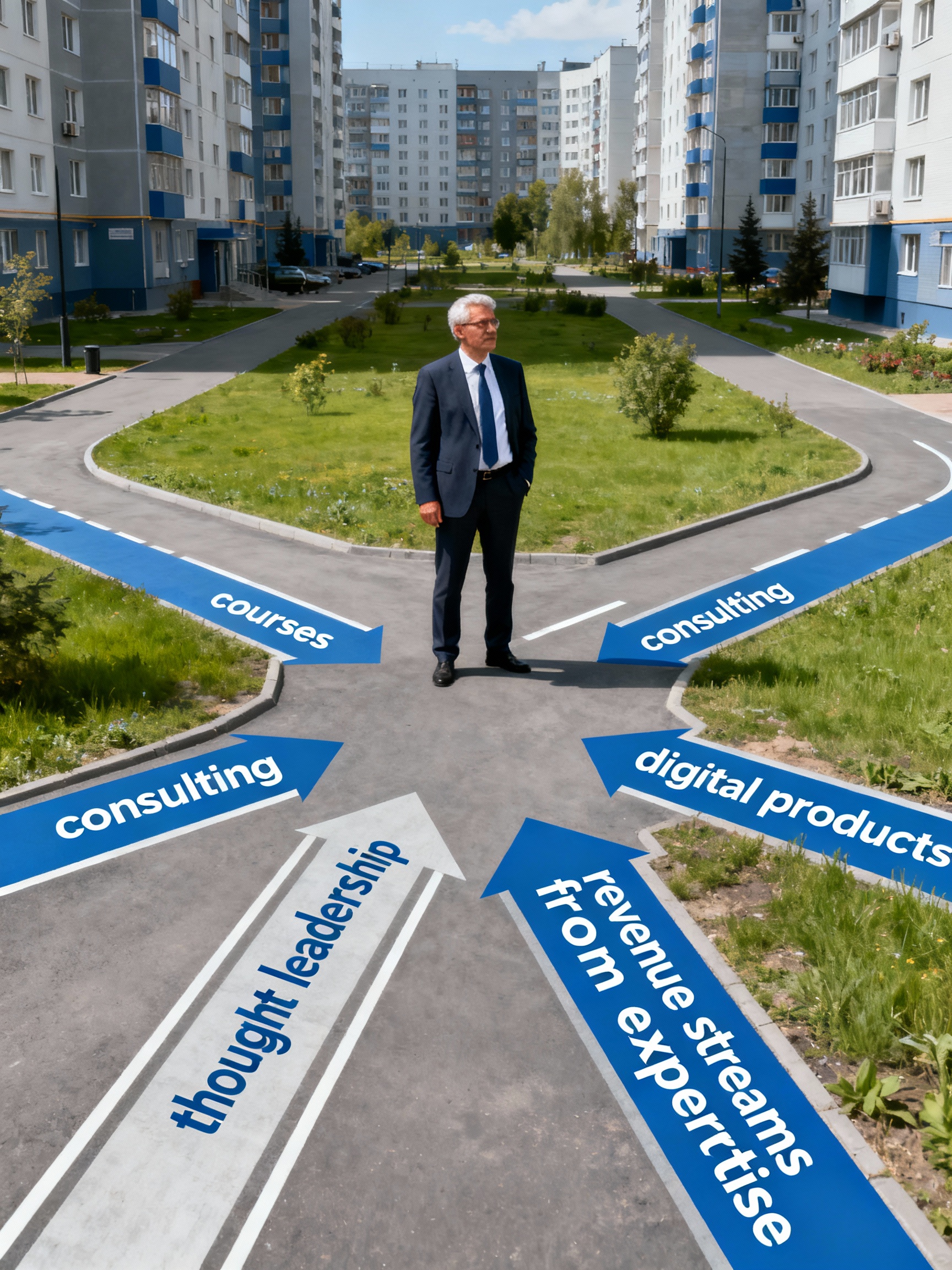
Why Architecture Expertise Remains Undermonetized
The architecture profession faces a peculiar paradox. Despite being highly skilled, well-educated professionals working on high-value projects, most architects earn less than their expertise justifies.
The reasons are systemic:
Architects trade time for money. In traditional practice, your income is capped by how many billable hours you can work per year. No matter how brilliant you are, there are only 8,760 hours in a year. Scale beyond that requires hiring staff—which adds overhead and complexity without fundamentally changing the economics.
Most architecture firms remain small. Globally, the median architecture firm has just 5-10 people. Firms at this scale can't afford to hire specialists in marketing, sales, or business development, so they remain invisible to potential new revenue streams.
Architects lack business training. Architectural education focuses on design, not entrepreneurship or business systems. Most architects become department heads or firm principals despite having zero formal business education.
Knowledge gets trapped inside firms. When you develop a brilliant solution to a design problem—a better workflow, an innovative layout strategy, an efficient cost-reduction method—that knowledge typically stays locked within your firm and your head. It's not documented, shared, or leveraged commercially.
The profession undervalues its own expertise. Many architects underprice their services because they don't understand their true value. They compare fees to competitors rather than pricing based on the value delivered to clients.
For someone like you—a department head with deep residential architecture expertise—this creates opportunity. Your knowledge is exactly what the market desperately needs, but you haven't yet monetized it.
Five Core Monetization Strategies for Architecture Knowledge
Strategy 1: Sell Pre-Designed Residential Plans
One of the most immediately executable monetization paths is packaging your proven residential designs as reproducible plan sets.
The model works like this: You've likely designed dozens of residential projects—apartment complexes, residential quarters, mixed-use developments. Select 3-5 of your strongest projects that represent different market segments (budget-conscious, mid-range, luxury segments).
Document these designs in publication-ready form: construction drawings, specifications, 3D visualizations, finishes schedules. Host them on a platform like your website or marketplaces like Archello or specialized residential design marketplaces.
-
Basic package: Discounted plan set for small modifications ($2,000-$5,000)
-
Professional package: Full design consultation plus customization ($10,000-$25,000)
-
Premium package: Complete site-specific adaptation with ongoing design support ($50,000+)
Why this works: Real estate developers in Myanmar, Southeast Asia, and emerging markets desperately need proven residential designs that balance aesthetics with market reality. Rather than paying a firm $100,000+ for custom design, they pay you $5,000-$15,000 for an adaptable template they can customize locally.
Energy requirement: Medium. Initial documentation effort is substantial, but recurring revenue per sale is pure profit.
Case study: Eric Reinholdt's 30X40 Design Workshop built a thriving online business around packaged residential plans. His model began with demand from people who wanted "that design" he'd created for his own house, and evolved into a scalable business.
Strategy 2: Create Digital Products—BIM Templates, Design Guides, Workflow Systems
Architecture firms are increasingly adopting Building Information Modeling (BIM) workflows using Revit. Yet most firms struggle to develop efficient Revit templates for their specific project types.
Your expertise is convertible into digital products:
Revit Templates for Residential Projects
-
Pre-built families for common residential elements (walls, windows, doors, fixtures)
-
Predefined detail libraries
-
Pre-configured sheets and schedules
-
Workflow documentation
Residential Architecture Design Guide (ebook or course)
-
Your philosophy on residential layout optimization
-
How to balance cost, aesthetics, and functionality
-
Design patterns that work in different climate zones and market contexts
-
How you approach constraints and budget limitations
Workflow & Production System Documentation
-
How your department manages projects from concept to construction
-
Quality control checklists
-
Coordination protocols
-
Client management systems
Price these digital products in the $100-$500 range for templates, $200-$1,000 for comprehensive guides. Volume sales create genuine recurring revenue with zero marginal delivery cost.
Why this works: Emerging firms, especially in developing markets like Myanmar, don't have the expertise to build these systems themselves. They'll pay for proven templates and guides that accelerate their capability development.
Energy requirement: High upfront (creating comprehensive templates and documentation), but then minimal maintenance.
Strategy 3: Online Courses and Masterclasses
The architecture education market is booming. Platforms like ArchiBiz, Eduwik, and Iasa Global offer structured online education to architects worldwide.
Your positioning: You're not teaching architecture history or theory (abundant online). You're teaching practical residential architecture expertise—the domain-specific knowledge that enables practitioners to be profitable and innovative.
Course topics you could develop:
-
"Residential Complex Development: From Design to Completion"
-
"Cost-Effective Apartment Layout Strategies"
-
"Client Management for Residential Architects"
-
"BIM Workflows for Residential Production"
-
"Market-Responsive Design Strategies"
Course structure: 6-12 weeks, once weekly live sessions + recorded content + assignments. Price: $300-$1,500 depending on depth and positioning.
Revenue model: 50-100 participants × $600 average price = $30,000-$60,000 per course offering. Two offerings per year = $60,000-$120,000 annual revenue from this channel alone.
Why this works: Architects globally need practical education that goes beyond academic theory. Your real-world residential expertise—especially adapted for different geographic markets—has genuine teaching value.
Energy requirement: Very high initial (building comprehensive curriculum and video production), then medium ongoing (delivery and iteration).
Strategy 4: Consulting and Technical Advisory Services
Many residential developers, smaller architecture firms, and real estate companies need expert guidance on specific challenges:
-
"We're designing a residential complex in Myanmar—how do we adapt standard design principles to local climate and market context?"
-
"Our firm wants to increase residential project revenue—how do we restructure our pricing?"
-
"We're building in Yangon—what are the key technical and regulatory challenges specific to Myanmar?"
You position yourself as a specialist consultant to these decision-makers.
Consulting structure: $200-$500/hour or $5,000-$15,000 per project-specific engagement. Three engagements per month = $15,000-$45,000 monthly additional revenue.
Why this works: You've solved complex residential architecture problems. Others will pay for that problem-solving transfer rather than learning through expensive mistakes.
Energy requirement: Medium-High. Consulting requires active time investment, but it's often the highest-margin work.
Strategy 5: Build a Personal Brand and Thought Leadership Platform
Architects who become recognized thought leaders command premium pricing across all monetization channels.
Build your platform through:
Content creation (blog, YouTube, LinkedIn):
-
Analyze residential design trends
-
Document your project case studies
-
Share your philosophy on residential architecture
-
Comment on market dynamics in Ekaterinburg, emerging markets, global trends
Professional speaking: AIA events, architecture conferences, continuing education sessions
Published writing: Magazine articles in architecture publications, industry journals
Social media authority: Instagram showcasing residential projects; LinkedIn positioning as expert
Why this works: Architects actively follow thought leaders on social media and look to them for guidance. As your visibility increases, all other monetization channels become easier—people want to buy courses from recognized experts, pay for consulting from authorities, and adopt templates from leaders.
Energy requirement: Medium ongoing. Consistency matters more than intensity.

The Energy Foundation: Why Most Architects Fail at Monetization
Here's where most expertise-to-revenue attempts fail: energy depletion.
You work full-time leading your department. That already requires significant energy and attention. When you attempt to simultaneously build online courses, consult for external clients, and maintain thought leadership, you're drawing energy from an already-taxed system.
By the third week, burnout hits. The content creation slows. The consulting business never launches. The course gets shelved.
The Super Jump methodology addresses precisely this problem. Before attempting to monetize your expertise, you need to restore your energy to sustainable levels.
The Energy Compass reveals the reality: if you're currently in the Aggression State (working frantically, high-stress, pushing yourself too hard), attempting to add monetization projects will only accelerate your burnout. If you're in the Powerlessness State (depleted, unmotivated despite ambitious goals), you lack the vitality to execute any of these strategies.
The pathway forward requires first returning to the Hero State—high energy combined with positive direction. From that foundation, monetization becomes manageable and sustainable.
Building Your Monetization Strategy: A Phased Approach
Rather than trying to execute all five strategies simultaneously, build sequentially:
Phase 1: Foundation and Energy Restoration (Weeks 1-4)
Your only goal is ensuring you have mental and physical space for this expansion.
-
Audit your current energy state using the Energy Compass
-
If you're depleted, begin the Super Jump 10-day intensive to restore baseline vitality
-
Create a Victory Journal documenting your existing expertise and accomplishments
-
Schedule protected time for monetization activities (2 hours weekly minimum)
Phase 2: Lowest-Friction Monetization (Weeks 5-12)
Start with your easiest revenue generator—likely Strategy 1 (selling plan sets) or Strategy 4 (consulting):
-
Document 1-2 of your strongest residential projects as plan sets
-
Launch a simple website or Behance portfolio for these plans
-
Accept 1-2 consulting engagements at $200/hour rates
Revenue goal: $3,000-$10,000 in this phase to prove concept
Phase 3: Scale Your Winner (Weeks 13-24)
Double down on whichever strategy generates the most revenue and energy:
-
If plan sets sold well, create 3-5 additional templates
-
If consulting resonated, systematize the process and market more actively
-
Begin documenting your methodology for future course/guide creation
Revenue goal: $15,000-$30,000
Phase 4: Systematic Expansion (Months 7+)
Once one revenue stream is established and running relatively autonomously, layer in the next:
-
Launch your BIM templates or design guide
-
Begin building online course curriculum
-
Increase consulting fees as demand proves value
Revenue goal: $50,000-$100,000 annually from monetized expertise
Why Your Timing Is Perfect
The global architecture market is experiencing significant structural shifts that work in your favor:
Rapid growth in emerging markets like Myanmar and Southeast Asia requires residential architecture expertise. Developers in these markets are desperately seeking proven designs and technical guidance.
Digital-first learning is now mainstream, especially post-pandemic. Architects expect to learn through online platforms, courses, and digital resources—creating demand for exactly what you can provide.
BIM workflows are becoming mandatory, not optional. Firms without efficient Revit templates and processes fall behind competitors. They'll pay for your systematized approach.
Consulting and thought leadership are commanding premium rates as complexity increases. A recognized expert in residential architecture can charge 2-3x what an unknown generalist can.
Remote work has normalized, making geographic location irrelevant. Your Ekaterinburg expertise can serve clients in Myanmar, London, South Africa, and globally.
The Super Jump Path to Sustainable Monetization
The 10-day Super Jump intensive specifically prepares you for this transition:
Day 1-2: Shift your state from Aggression/Powerlessness to stable baseline through breathing practices and nervous system regulation
Day 3-5: Rebuild your psychological energy reserves and emotional resilience
Day 6-8: Clarify your "Super Goal"—not just earning more money, but creating a sustainable architecture practice aligned with your values and capabilities
Day 9-10: Develop accountability structures and community connections to sustain your monetization journey
Post-course, you receive 21 days of community support as you begin executing your monetization strategy.
Participants report: by day 3, mental clarity returns; by day 7, they're ready to take action; by day 21, concrete monetization initiatives are underway.
Your Next Step
The knowledge you've accumulated leading an architecture department is genuinely valuable. Markets exist that will pay for it. The barrier is not market demand or competitive advantage—it's your own energy and clarity of execution.
Begin here:
Audit Your Current State: Use the Energy Compass assessment to honestly assess where you are. Are you in Hero State, Peace, Aggression, or Powerlessness?
Restore Energy First: If you're depleted, spend the next 10 days doing Super Jump intensive before launching any monetization initiative. You can't build sustainable revenue while running on empty.
Document Your Expertise: Create a simple inventory of your 5 strongest residential projects, your core design philosophies, and the systems you've built.
Choose Your Entry Strategy: Pick one of the five monetization strategies that requires the least initial barrier to entry for you (likely consulting or plan sets).
Execute Phase 1: Launch your first revenue stream within 30 days.
Call to Action
If you're ready to transform your architecture expertise into sustainable revenue, the Super Jump Intellect-Club can provide the energy foundation and accountability you need.
Get a free consultation via Telegram: @Tatiana19561203
Download the free PDF guide "Energy as Currency" and discover how to redirect your life force toward high-value activities (like monetizing your expertise) rather than energy-draining tasks
Learn more and explore your options: https://intellectclubonlineshop.ru/
Join the 10-day intensive course (completely online, accessible from anywhere): Register at https://account.superjump.com/register/86736, select the course in the catalogue, and choose the subscription at $200
Discover the methodology through our Telegram bot (Russian-language guidance available): https://cp.puzzlebot.top/LbldJjCbn7WEBU
Your expertise is valuable. Now it's time to prove it through revenue.