












Your child is entering 7th grade or navigating it now, and you're noticing something that concerns you. They're quiet. They observe more than they participate. In class presentations, their anxiety is visible. At lunch, they're often alone or on the periphery of groups. You know they have interesting thoughts—you hear them at home—but at school, they seem invisible. And you're wondering: How do I help them communicate confidently, find their people, and build a genuine sense of belonging?
In Nairobi and across Kenya, where secondary school transitions are major life shifts accompanied by significant social pressures, bullying, and the challenge of navigating complex peer hierarchies, many parents face this exact question. How do you teach communication skills that actually work in real social situations? How do you help your child develop the confidence to speak up, contribute to conversations, and feel genuinely accepted by their peer group?
The answer requires understanding both the neuroscience of adolescent development and the specific barriers your child faces.
Why 7th Grade Is the Critical Inflection Point
Seventh grade (ages 12-13) represents a crucial developmental juncture. Your child's brain is undergoing significant reorganisation:
The adolescent brain becomes hyperaware of peer perception. During this period, the same neural regions activated by physical pain are activated by social rejection. This isn't drama or exaggeration—it's neurobiology. Rejection genuinely hurts at this age.
Identity formation accelerates. Your child is no longer content to be "mom and dad's kid." They're asking: Who am I? Where do I fit? What makes me interesting and valuable to my peers? This identity search is healthy and necessary, but it makes peer acceptance feel existentially important.
Social complexity explodes. Unlike elementary school where friendship groups were relatively stable, middle school introduces dozens of teachers, hundreds of peers, multiple lunch periods, and constantly shifting social dynamics. Your child must navigate this new landscape while their emotional regulation is still developing.
Executive function improvements create new possibilities. For the first time, your child can engage in abstract thinking about social situations. They can anticipate conversations, consider others' perspectives, and plan social strategies. But they can also ruminate, catastrophise, and develop social anxiety if support is lacking.
Here's what research conclusively shows: Students with strong social skills and peer acceptance in 7th grade show significantly better academic performance, higher self-esteem, fewer behavioural problems, and better mental health across their entire adolescence and into adulthood.
Conversely, social rejection and loneliness at this age predict higher rates of social anxiety, depression, school disengagement, and academic underperformance well into adulthood.
The stakes are real. This is the time to intervene.

Understanding Your Child's Specific Barrier
Before teaching communication skills, you need to understand what's actually blocking your child. Different barriers require different interventions:
Barrier 1: Genuine Anxiety About Social Evaluation
Some children aren't quiet from personality preference—they're quiet from fear. Specifically, fear that they'll be judged, rejected, or humiliated if they speak.
Signs of this barrier:
-
Physical anxiety symptoms (sweating, trembling, difficulty breathing) when called on in class
-
Avoidance of social situations, even ones they want to attend
-
Rumination ("If I say something, they'll think I'm stupid")
-
Catastrophic thinking ("Everyone will laugh at me if I mess up")
-
Perfectionism (only speaks if they're 100% certain they're correct)
This is social anxiety, and it's more common than you might think. Approximately 5-10% of adolescents experience clinical social anxiety disorder, and many more experience significant social anxiety symptoms.
Why it develops: Research identifies three primary pathways to adolescent social anxiety:
The anxiety becomes self-perpetuating: anxious child avoids speaking → peers don't get to know them → peers assume they're stuck-up or unfriendly → peer acceptance decreases → anxiety increases.
The intervention approach: Exposure therapy with skill-building. Your child needs both to practice social situations (despite anxiety) and to build actual communication competence so there's genuine reason for confidence, not forced positive thinking.
Barrier 2: Learned Introversion or Shyness Without Anxiety
Some children are genuinely introverted—they process internally, prefer small groups, and need time to warm up. This is not pathological. But in a highly social school environment, introversion without communication skills becomes disadvantageous.
Signs of this barrier:
-
Comfortability in one-on-one or small-group settings but quietness in larger groups
-
Takes time to warm up but eventually opens up
-
Observant; notices social dynamics others miss
-
Isn't anxious per se, just prefers not to draw attention
-
Has friendships but fewer than extroverted peers
Why it matters: Introverted kids don't struggle because something is wrong with them. They struggle because schools reward extroversion—speaking up in class, participating in group projects, joining clubs—and many introverted kids haven't learned that they can participate authentically as themselves rather than pretending to be extroverted.
The intervention approach: Teaching "strategic extroversion"—how to communicate effectively without changing fundamental personality. The goal is helping them understand that it's possible to be genuinely introverted AND participate meaningfully in social environments.
Barrier 3: Communication Skill Deficit (Not Anxiety or Personality)
Some children actually lack specific social skills. They might:
-
Struggle to initiate conversations
-
Miss social cues (when someone's interested vs. uninterested in talking)
-
Monopolise conversations or fail to listen well
-
Have trouble with perspective-taking (understanding others' viewpoints)
-
Struggle with conflict resolution
-
Don't know how to join existing groups
This is different from anxiety—they're willing to try; they just lack the specific skills to succeed.
The intervention approach: Direct skill teaching through role-play, observation, and practice in real situations.
Barrier 4: Energy Depletion and Burnout
Here's the barrier most people miss: many quieter, withdrawn 7th graders aren't anxious or introverted—they're depleted.
In Kenya's education system, secondary school introduces intense academic pressure, multiple subjects, increased workload, and often difficult transitions (especially in boarding schools). Combined with typical adolescent social stress, many kids hit Powerlessness State—low energy, negative emotion.
From this depleted state, social participation feels impossible:
-
Speaking up requires energy they don't have
-
Maintaining friendships feels exhausting
-
Group participation overwhelms their depleted nervous system
Signs of burnout vs. anxiety:
-
Pervasive exhaustion despite adequate sleep
-
Loss of interest in activities they used to enjoy
-
Difficulty concentrating even when trying hard
-
Physical symptoms (headaches, stomach problems, sleep disturbance)
-
Cynicism or emotional flatness
The intervention approach: Before teaching communication skills, restore energy. A depleted child cannot execute new social skills effectively.
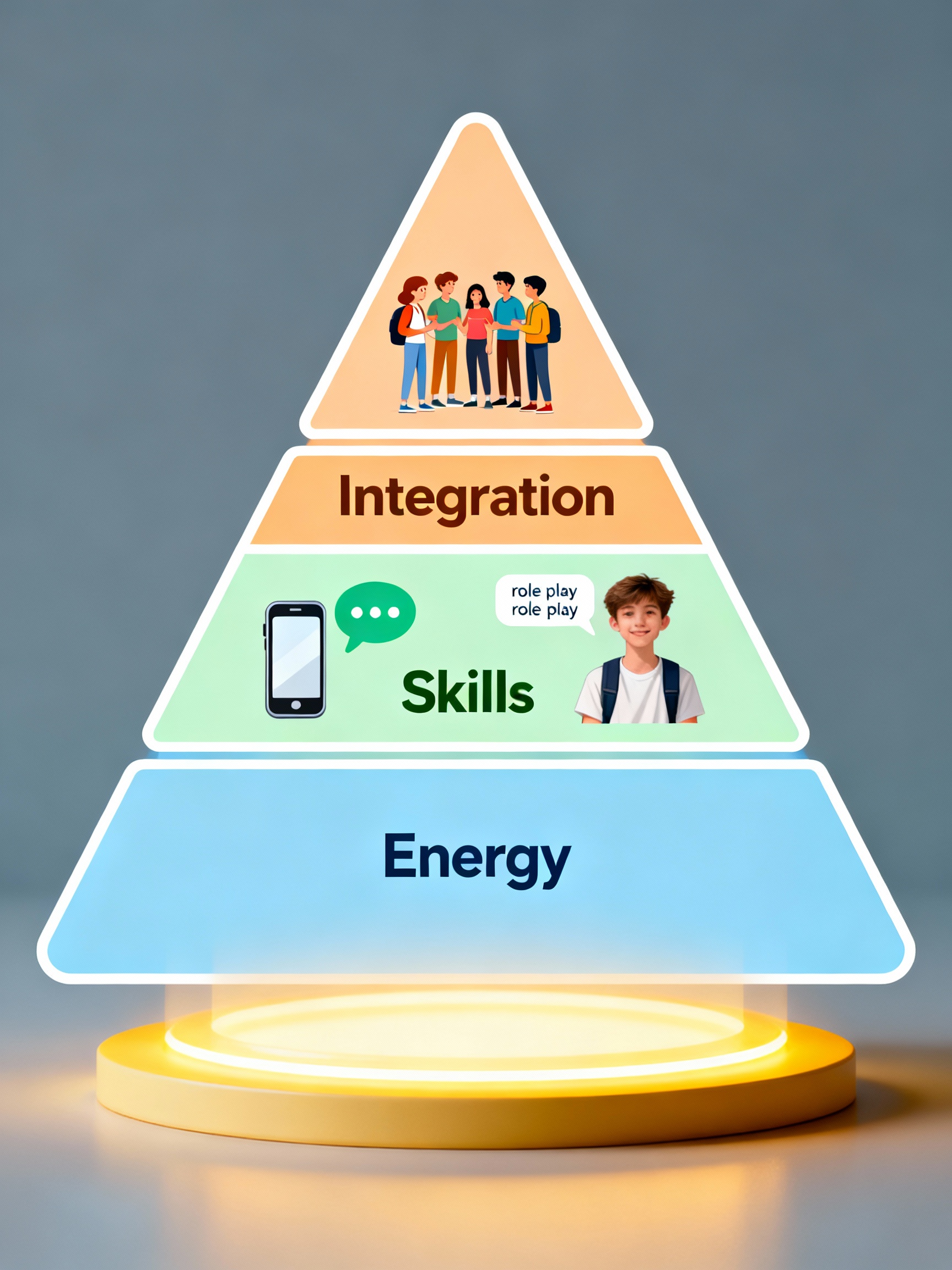
The Three-Phase Framework: Energy, Skills, Integration
Once you've identified your child's specific barrier, here's the systematic approach that actually works:
Phase 1: Restore Energy and Create Safety (2-4 weeks)
If your child is in Powerlessness State—whether from burnout, chronic anxiety, or accumulated social stress—teaching communication skills is pointless. You're trying to build second-floor rooms on a broken foundation.
Your tasks:
-
Create a safe, non-judgmental home space where your child can decompress without performing or defending themselves
-
Establish basic nervous system regulation: consistent sleep, exercise, downtime without screens
-
Have conversations (not lectures) where you listen more than you speak
-
Explicitly communicate: "I notice you seem stressed. I'm here to understand what's happening, not to fix or judge"
-
Consider whether your child might benefit from Super Jump or similar energy-restoration practices—many adolescents report immediate shifts in confidence after even 2-3 days
The goal is moving your child from Powerlessness State toward Peace State (stable baseline) or Hero State (energised and capable).
Phase 2: Develop Specific Communication Skills (4-12 weeks)
Now that your child has baseline energy, teach specific social and communication skills through practice, not lecture:
Skill 1: Conversation Initiation and Maintenance
Teach: "Conversation is reciprocal. It's not about saying smart things. It's about taking turns asking questions and sharing."
Practice script:
-
"Hi, I'm [name]. I noticed you [specific observation]. What's that about?" (People like being asked about themselves)
-
Listen to response
-
Share something related: "That's cool. I've [similar experience]"
Role-play this at home with different scenarios: joining lunch group, meeting someone in class, talking to a group at an event.
Skill 2: Reading Social Cues
Teach explicit recognition of:
-
Interest signals: eye contact, leaning in, responsive expressions, asking follow-up questions
-
Disinterest signals: minimal eye contact, body turned away, short answers, looking for exit
-
Invitation to join signals: looking at you, making space, slowing down conversation
-
Don't-join signals: tight group circle, inside jokes you're not part of, ignoring your approach
Discuss these during TV shows, movies, or real-life observations: "See how they're standing? Is that group open to someone joining?"
Skill 3: Perspective-Taking
Teach your child to explicitly consider: "What might they be thinking? How might they be feeling? What's important to them?"
This is abstract thinking that develops during adolescence but requires practice.
Skill 4: Authentic Participation
Teach: "You don't have to become someone different to participate. You just need to find your specific contribution."
In group projects or classroom discussions, different contributions are valuable:
-
Some people have big ideas
-
Some people notice what others miss
-
Some people ask good questions
-
Some people listen well and help people feel understood
Your child's job isn't to be extroverted. It's to be authentically present and find where their natural style adds value.
Phase 3: Guided Integration Into Real Social Situations (8+ weeks, ongoing)
Skills practiced at home mean nothing if they don't transfer to real school environments. Your role now is guided practice:
Structure 1: Before-Event Rehearsal
Before social situations (school project, group activity, social event), rehearse:
-
"What might happen?"
-
"How could you participate authentically?"
-
"What's your role or contribution?"
Structure 2: After-Event Debrief
After social situations, debrief (not interrogate):
-
"How did that go?"
-
"Did anything feel challenging?"
-
"What worked well?"
This builds reflection and learning—essential for social skill development.
Structure 3: Small-Group Practice
If possible, enroll your child in small groups where social interaction is built-in: sports, clubs, volunteer groups, or structured social skills groups.
Small groups (5-8 people) provide the perfect laboratory for practicing social skills with less pressure than full class environments.
Structure 4: One-on-One Connection
Help your child develop at least one close friendship. Research shows that even one close friend buffers against social anxiety and provides emotional support for navigating peer dynamics.
You might facilitate this by:
-
Suggesting small gatherings (two friends is less intimidating than groups)
-
Supporting activities they both enjoy
The Role of Energy: Why Your Child Needs More Than Communication Skills
Here's what most parenting advice misses: you cannot teach sustained social participation to a depleted child.
Many 7th graders appear socially withdrawn, but they're actually experiencing burnout from academic pressure, transition stress, and the overwhelming complexity of adolescence.
Before implementing skill-building, assess: Is my child actually depleted?
-
Chronic exhaustion ("I'm always tired")
-
Loss of interest in previously enjoyed activities
-
Difficulty concentrating despite effort
-
Emotional flatness or mood swings
-
Physical symptoms (headaches, stomach problems)
-
Sleep disturbance
-
Social withdrawal
-
Cynicism or hopelessness about the future
If your child shows these signs, energy restoration must come before skill-building.
The Super Jump methodology is specifically designed for adolescents experiencing these dynamics:
Laughter-Charge Breathing teaches your child to regulate their nervous system and trigger endorphin release—shifting from Powerlessness toward activation.
The Victory Journal helps rebuild confidence and self-belief when depleted.
Energy Compass awareness teaches your child to recognise which situations and people energise vs. deplete them—essential for creating sustainable social engagement.
Many adolescents who try Super Jump report immediate shifts in confidence and social engagement by day 3-5. Not because the communication skills suddenly became better, but because their energy state improved, making authentic participation possible.
Nairobi Context: Specific Considerations
In Kenya, particularly Nairobi schools, 7th graders face specific challenges that international research doesn't always address:
Academic pressure is intense. Kenya's exam-focused system means grades feel like life-or-death to both students and parents. This pressure can contribute to burnout and social withdrawal.
Bullying and aggression are documented challenges. Older students bullying Form One (7th grade) students is a recognized problem in Nairobi schools. Social skills alone won't solve bullying, but confidence and supportive peer groups buffer against its effects.
Transition to secondary school is disruptive. If your child is transitioning from primary to secondary school (especially boarding school), they're leaving established peer groups and facing a completely new social hierarchy.
Protective factors that work in Nairobi context:
-
Strong sense of school belonging and community (even in challenging contexts)
-
Peer support networks and friendships
-
Mentorship and guidance from adults
-
Self-confidence and ability to speak up
-
Time management and stress coping skills
-
Ability to resist peer pressure and choose friends wisely
These are precisely what communication skill development provides.
The Practical First Step
If your 7th grader is struggling with social participation and communication, here's your starting point:
Week 1: Assess the Real Barrier
Is this anxiety-based, introversion-based, skill-deficit, or energy depletion? Honest observation will reveal the pattern. Talk to your child: "I've noticed you're quieter at school. Help me understand what that's like for you."
Week 2-3: Restore Energy if Needed
If burnout is evident, make this the priority. Talk to your child about Super Jump or similar practices. The goal is moving them from depleted to stabilized.
Week 4+: Build Skills
Once energised, begin practicing conversation skills, perspective-taking, and authentic participation through the methods above.
Ongoing: Guided Practice
Support your child through real social situations with before-rehearsal and after-debriefing.
The Long-Term View: Building Lifelong Social Confidence
What you're building now isn't just "better social skills." You're building your child's capacity to:
-
Navigate complex social environments with confidence and authenticity
-
Develop close friendships and supportive peer relationships
-
Contribute meaningfully to groups while respecting their own personality
-
Recover from social setbacks without shame
-
Find belonging and acceptance
-
Build the social confidence that predicts wellbeing far into adulthood
This foundation, built in 7th grade, determines much of your child's social trajectory through adolescence and beyond.
If your 7th grader is struggling with social communication and finding their place in the school collective—particularly if you're in Nairobi, Kenya—support is available:
Get a free family consultation via Telegram: @Tatiana19561203
Download the free PDF guide "Energy as Currency" and discover whether your child's social withdrawal might reflect energy depletion—and how to restore that foundation
Learn about adolescent-focused Super Jump programs: https://intellectclubonlineshop.ru/
Consider Super Jump as family foundation work (many parents do it alongside their teens for shared learning): Register at https://account.superjump.com/register/86736, select the course in the catalogue, and choose subscription at $200 per person
Parents who've seen their teens transform through energy restoration + skills practice report: "They speak up in class now." "They actually went to the lunch group." "I see them laughing and engaged." "They have real friends."
Explore the methodology via Telegram bot: https://cp.puzzlebot.top/LbldJjCbn7WEBU
Your 7th grader doesn't have to spend middle school on the periphery. With energy restoration, targeted skill-building, and authentic support, they can find their voice, build genuine connections, and develop the social confidence that carries them forward.
Start this week. Your child's adolescent experience—and adult social wellbeing—depends on it.