












You have a genuine, valuable project focused on habit formation. You know the science: sleep hygiene, nutrition, meditation, physical fitness—these foundational habits transform lives. You can see the impact clearly. Yet when you try to communicate this to the world, something feels off. Your message disappears into noise. People nod politely, then continue their ineffective routines. You're not failing. The market is failing you.
Here's the brutal truth: 98% of habit-change initiatives fail because they're built on the wrong foundation. And the market is saturated with them.
The personal development market alone is worth $40+ billion globally and growing at 5% annually. The wellness market is exploding. Gen Z and millennials represent 40% of wellness spending, and they're desperately seeking solutions.
Yet research reveals that over 50% of people abandon wellness initiatives within 30 days.
The problem isn't lack of demand. It's not lack of messaging. It's that you're speaking to the wrong people about the wrong problem, using the wrong framework.
And in Nicosia and across Cyprus, where the digital fitness and wellness market is projected to reach $20.8 million in 2025 with significant growth momentum, there exists a massive opportunity for someone who understands this difference.

The Market Saturation Illusion
When you look at the wellness space, it feels impossible to differentiate. There are meditation apps (Calm, Headspace), fitness platforms (Peloton, Apple Fitness+), sleep optimization products (Oura Ring, WHOOP), nutrition coaching services, mindfulness retreats—an endless parade of solutions, all competing on the same message: "Transform your life through better habits".
McKinsey's 2025 Future of Wellness research reveals the problem clearly:
The market has fragmented into distinct consumer segments, and traditional messaging no longer works for anyone:
"Maximalist Optimizers" (25% of consumers, 40% of spending) are digitally savvy, do extensive research, and seek science-backed solutions. They're not convinced by emotional appeals—they want data, research, and proof.
"Confident Enthusiasts" (11% of consumers, 15% of spending) already know what works for them and stick with it. They're unlikely to switch solutions.
"Wellness Warriors" are committed but occasionally falter.
"Casual Consumers" struggle to implement anything and need friction reduced and motivation increased through gamification.
"Wellness Shirkers" aren't interested at all.
Here's what most habit-change projects miss: they're trying to speak to all segments with one message. They market "transform your life" as if everyone wants transformation at the same cost.
In reality, each segment needs radically different value propositions:
-
Maximalist Optimizers need scientific validation and data integration
-
Confident Enthusiasts need community and social proof that reinforces their existing choices
-
Casual Consumers need simplified implementation with accountability
The Real Problem: Why Habit Programs Fail (It's Not What You Think)
The most insidious finding from adherence research is this: people know what to do. The barrier isn't knowledge. It's energy and implementation.
Research on medication adherence (which parallels habit formation across domains) reveals that over 700 factors influence whether people follow through. But here's what's shocking: reminders, education, and motivation don't significantly improve adherence.
What does work? Reducing variability in implementation.
The study found that people who took medications at the same time each day with low variability had 30%+ better adherence than those with high variability. Not because they were more motivated. But because consistency created automaticity.
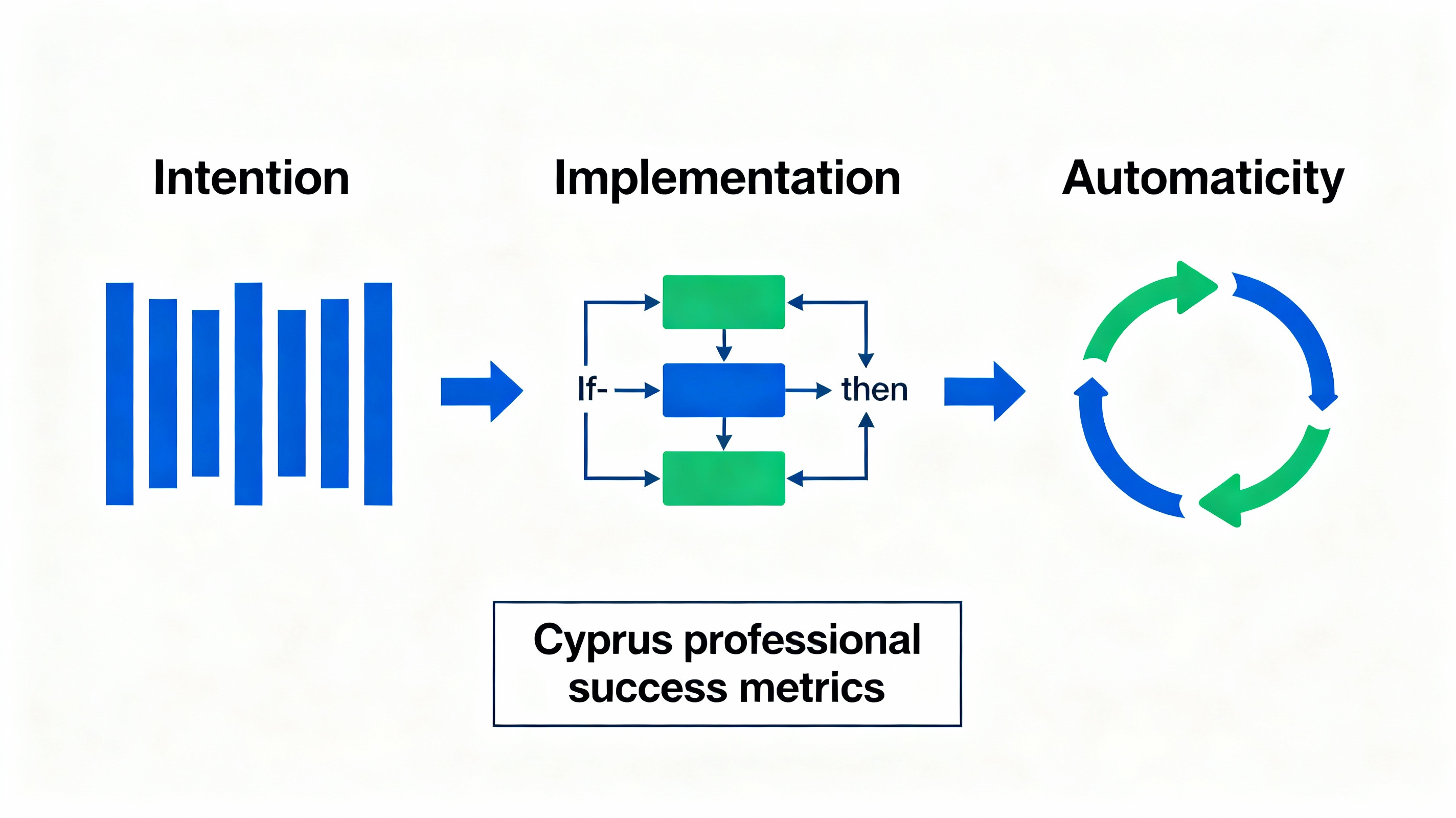
This points to the real solution framework: implementation intentions and habit stacking, not motivation and willpower.
Implementation intentions follow the formula: "If [situation], then I will [behaviour]":
-
"If I finish my morning coffee, then I will do 10 minutes of meditation"
-
"If my alarm goes off at 7am, then I will exercise"
-
"If I sit at my desk to work, then I will first drink water"
This "if-then" planning has medium-to-large effect sizes for goal attainment across diverse behaviours.
Habit stacking pairs a new desired habit with an existing automatic one:
-
New habit: Morning meditation
-
Anchor habit: After I pour my coffee
Why does this work when motivation fails? Because it bypasses the motivation system entirely. It leverages automaticity and environmental cues instead of relying on willpower.
The Positioning Mistake: You're Selling "Transformation" When You Should Be Selling "Implementation"
Here's where your message is likely failing: You're probably promising transformation, clearer thinking, better life, more energy, deeper sleep, better fitness.
These are outcomes. Outcomes are what everyone promises.
What the market is desperate for—what's actually missing—is a clear, systematic method for reducing the friction between intention and action.
Most people intend to sleep better. They don't need convincing. They need the method to make it automatic despite chaos.
Most people want to exercise. They're not lacking motivation. They lack the implementation structure that makes it non-negotiable despite distractions.
This is your differentiation opportunity.
Rather than positioning your project as "better sleep, better nutrition, better fitness, better meditation," position it as:
"The Operating System for Making Habits Stick When Life Gets Chaotic"
Or:
"Implementation Without Willpower: How to Automate Your Way to Better Habits"
Or (more specifically):
"From Knowing What To Do to Actually Doing It: The Habit Stacking Framework That Works for Real Life"
Notice the shift? You're not promising transformation. You're solving the real problem: how to move from intention to consistent action despite life's chaos.
Understanding Your Ideal Audience
In Cyprus—particularly in Nicosia where the wellness market is booming—who desperately needs this?
Your primary target: "Casual Consumers" who struggle with implementation
These are people who:
Why target this segment?
-
They'll pay for solutions that actually work for them (unlike those already satisfied)
-
Their lifetime value is high—if your system works, they stay
-
They're underserved by current offerings (which assume high motivation)
Secondary target: Professionals in high-stress roles who've lost energy
People who:
-
Used to have good habits but abandoned them due to work stress
-
Have depleted psychological energy
-
Want habits not for aesthetic reasons but for survival—better sleep so they can think clearly, exercise so they can manage stress
-
Will pay premium prices for solutions that work within real constraints
This is where the Super Jump methodology becomes particularly relevant. People in burnout aren't struggling with motivation. They're struggling with energy depletion. Their habit systems collapsed not because they lack willpower, but because they ran out of fuel.
Your Positioning Framework: The Four-Part Value Proposition
According to Harvard Business School research on personal value propositions, your message should answer four questions:
1. Who do I want to create value for?
Answer: Professionals in Nicosia and Cyprus who know they should have better habits but keep failing despite good intentions. Primarily ages 25-45, employed or entrepreneurial, experiencing work-related stress.
2. What value do I uniquely offer?
Answer: Not another motivational program. A systematic framework that reduces implementation friction by using habit stacking and implementation intentions—methods proven in neuroscience and behavioral psychology but rarely used in commercial habit programs.
3. How am I different from other habit solutions?
Answer: Most habit programs focus on motivation and willpower. They assume the problem is lack of desire. You solve the real problem: the gap between intention and action. Your framework works for people who are already motivated but struggle with consistency—precisely the market that's most underserved.
4. What evidence do I have?
Answer: Research on implementation intentions (medium-to-large effect sizes), habit stacking efficacy, adherence data (30%+ better when using consistent timing), and the Cyprus wellness market demand.
The Messaging Framework: From Saturation to Dominance
Instead of:
"Transform your life through better sleep, nutrition, meditation, and fitness"
Say:
"The implementation framework that turns habit intentions into automatic action—even when life gets chaotic"
Instead of:
"Join thousands who've improved their lives"
Say:
"The system used by professionals who tried everything else and finally found what works: turning good intentions into non-negotiable routines through habit stacking"
Instead of:
"Our comprehensive program covers all aspects of wellness"
Say:
"We solve the one problem every habit program ignores: how to actually execute the habits you already know you should do. Using neuroscience-based implementation methods."
The Super Jump Connection: Energy as the Foundation
Here's where your habit project intersects powerfully with the Super Jump methodology:
Most habit failures occur not because people lack knowledge or motivation, but because they lack energy.
A person in the Powerlessness State (low energy, negative emotion) cannot execute even the simplest habit stack. They can't get out of bed, let alone meditate.
A person in the Aggression State (high energy, negative emotion) has energy for habits, but their stress and reactivity sabotage implementation.
Only someone in the Hero State (high energy, positive emotion) can reliably execute the implementation intentions you teach.
This means your optimal positioning includes energy restoration as foundational:
Your Complete Framework:
-
Restore energy to baseline (Hero State)
-
From that foundation, teach implementation intentions and habit stacking
-
Build community accountability to sustain habits
This isn't additional—it's the reason your program works when others fail.
Practical Steps to Position Your Project for Maximum Impact
Step 1: Define Your Specific Positioning
Write this down:
"For [specific target audience in Nicosia], my habit project is the [specific differentiation] solution that [specific value], unlike other programs that [what competitors do instead]"
Example:
"For stressed professionals in Nicosia who've failed at multiple habit programs, my project is the neuroscience-based implementation framework that turns good intentions into automatic routines, unlike motivational programs that assume the problem is lack of desire"
Step 2: Identify Your Hero Customer Story
Find one person who represents your ideal customer:
-
Knew habits mattered
-
Tried multiple programs
-
Failed due to implementation friction (not motivation)
-
Succeeded using your framework
Tell this story obsessively in all marketing.
Step 3: Create Your Proof Points
Package your evidence:
Don't just claim the framework works. Show the neuroscience behind why it must work.
Step 4: Build Your Distribution Channels for Cyprus/Nicosia
Where does your target audience spend time?
-
LinkedIn (professionals seeking better productivity)
-
WhatsApp business communities
-
Corporate wellness programs
-
Therapy and coaching communities
-
Super Jump community (where energy-aware individuals congregate)
Don't try to be everywhere. Be unavoidable in the channels where your specific target spends time.
Step 5: Package Your Offering
Rather than "complete wellness program," offer:
-
Entry Program: "Implementation Intentions Blueprint" ($97-197) - teaches the if-then framework
-
Core Program: "Habit Stacking for Real Life" (10-week course, $297-497) - teaches habit stacking + accountability
-
Premium Program: "Energy-Based Habit Architecture" (personalized, $2,000+) - combines energy restoration (like Super Jump) + habit stacking
Each tier targets different customer segments and willingness to pay.
The Energy-Habit Integration: Your Competitive Moat
Here's your strategic advantage: combine what most habit programs never mention (energy) with what most energy programs never focus on (specific habit implementation).
The Super Jump framework gives you the energy foundation. Your habit project gives you the implementation architecture.
Together, they create a complete operating system for change:
Phase 1: Energy Restoration (10 days)
Participant returns to Hero State through breathing practices, Victory Journal, attention management. Only now do they have the psychological bandwidth for habit change.
Phase 2: Implementation Architecture (Weeks 2-8)
Participant learns habit stacking, implementation intentions, and environmental design. They build their specific habit system aligned with their energy and constraints.
Phase 3: Accountability and Iteration (Ongoing)
Community support and tracking ensure consistency and adaptation.
This integration is exactly what's missing from the market.
Your Call to Action: From Theory to Execution
If you're in Nicosia or anywhere in Cyprus, and your habit project is ready to finally break through market saturation, here's what works:
1. Clarify your positioning using the framework above
2. Connect with Super Jump to build the energy foundation that most habit programs lack
3. Integrate both into a comprehensive system
The market doesn't need another motivation program. It desperately needs the implementation framework that actually works—especially combined with energy restoration.
That's your differentiation. That's your path through saturation to market dominance.
If you're ready to scale your habit project with the complete positioning and energy framework it deserves:
Get a free consultation via Telegram: @Tatiana19561203
Download the free PDF guide "Energy as Currency" and discover why habit programs fail when energy is depleted—and how to build this foundation
Learn more about building sustainable habits with energy awareness: https://intellectclubonlineshop.ru/
Join the Super Jump 10-day intensive together with your program participants (create a cohort in Cyprus): Register at https://account.superjump.com/register/86736, select the course in the catalogue, and choose the subscription at $200 per person
Many successful habit coaches and program developers use Super Jump as their personal foundation—then teach their specialized framework from that grounded state.
Explore the methodology via Telegram bot: https://cp.puzzlebot.top/LbldJjCbn7WEBU
Your habit project doesn't have to disappear into market noise. Position it as the implementation framework it is. Ground it in the energy foundation that actually works. Then watch how quickly adoption accelerates.
The Nicosia market is ready for this. Across Cyprus, professionals are tired of failing at habits. They want the system that actually works—not another motivational speech, but the neuroscience-based framework that turns intentions into automatic action.
That's your positioning. That's your opportunity. Build it.